Licensing Regulations Drive Subtle Shifts in Blackjack Payouts Between Neighboring States
Otto Lehmann · Aug 16, 2026
Licensing Regulations Drive Subtle Shifts in Blackjack Payouts Between Neighboring States
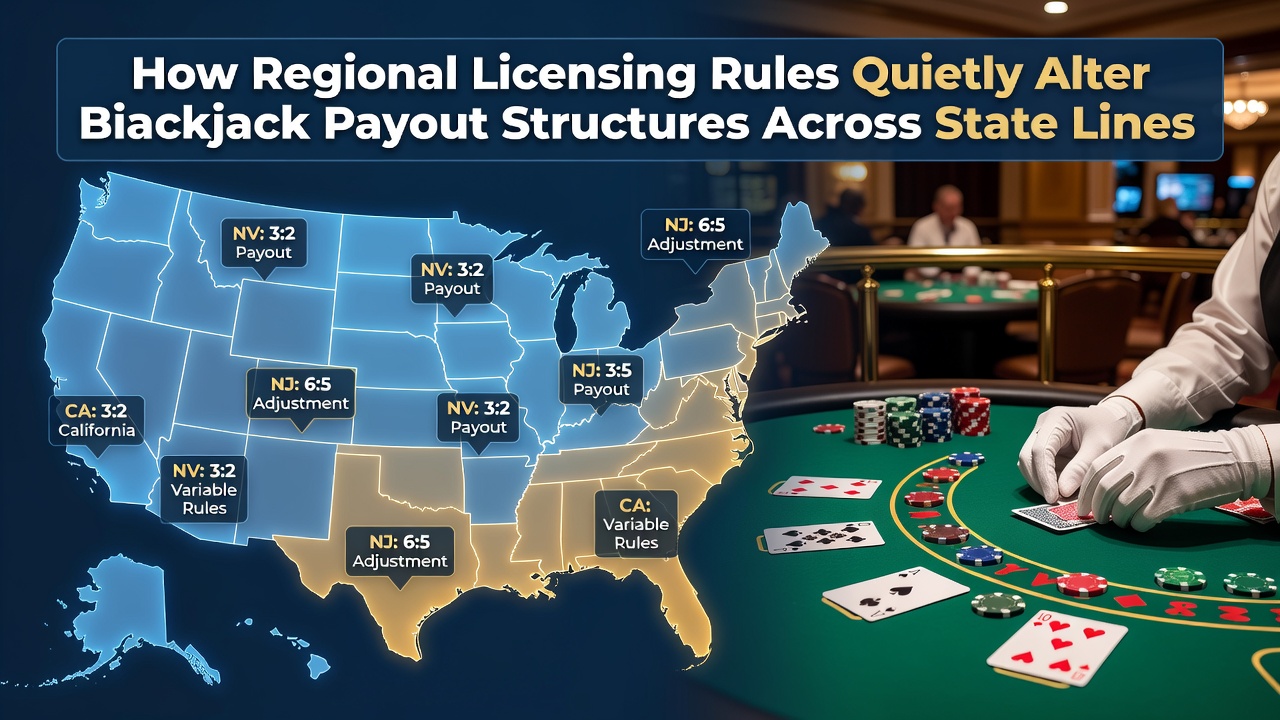
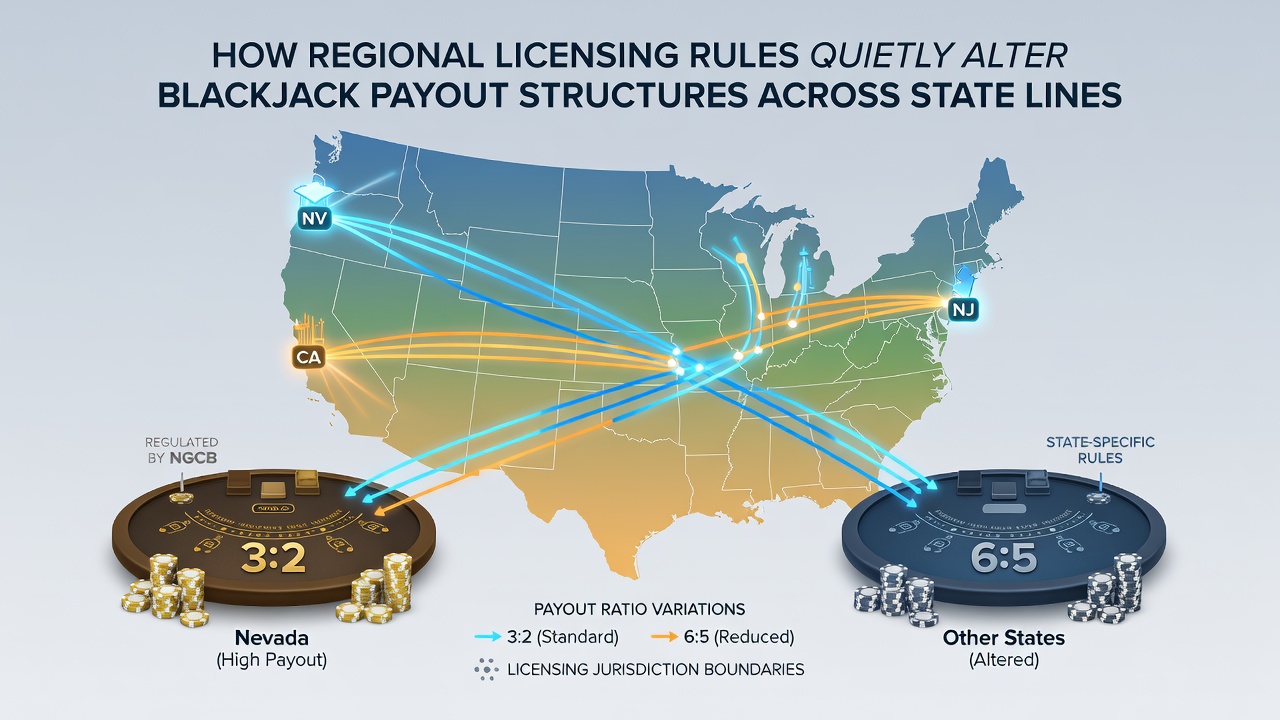
State gaming commissions set the precise terms under which casinos may operate blackjack tables, and those terms include the payout ratios that determine how much players receive on winning hands. Licensing agreements in one jurisdiction frequently specify 3:2 payouts on natural blackjacks while neighboring states permit 6:5 ratios under different regulatory frameworks, creating measurable differences that appear only when players cross state lines.
According to records maintained by the Nevada Gaming Control Board, casinos operating under full resort licenses must maintain at least one 3:2 blackjack table for every two 6:5 tables, a requirement tied directly to the renewal conditions of their operating permits. Adjacent states such as California apply no such ratio mandate because tribal compacts negotiated with individual tribes govern the games instead, allowing operators to standardize 6:5 payouts across entire floors without violating licensing terms.
Regulatory Language Embedded in License Conditions
Licensing documents list the exact mathematical structure of permitted games, and those lists differ sharply from one state capital to the next. Pennsylvania's Gaming Control Board requires that any table offering 6:5 payouts must also post a visible notice of the reduced return, whereas Illinois regulations contain no equivalent disclosure clause because the state's licensing statute focuses instead on minimum table minimums and staffing ratios.
Observers note that these embedded clauses travel with the license itself, so when a casino group expands across state borders it must adopt the payout structure dictated by the new jurisdiction rather than carry over the model used at its home property. Data compiled by the Missouri Gaming Commission shows that after two major operators relocated certain blackjack variants from Nevada licenses to Missouri licenses in 2025, average player return on those games dropped by 0.85 percentage points within the first six months of operation under the new rules.
Examples of Cross-Border Variation in August 2026
During August 2026, several properties located near state borders adjusted table configurations to align with updated license conditions. Casinos in Stateline, Nevada continued to advertise multiple 3:2 tables because their permits still carried the ratio requirement, while facilities just across the line in California offered exclusively 6:5 games under tribal compacts that impose no such ratio. Players moving between the two locations encountered an immediate difference in expected return on the same wager size, a change produced solely by the licensing language in each jurisdiction.
Similar patterns appear along the Nevada-Arizona border where Arizona's Department of Gaming permits 6:5 as the default structure for all new licenses issued after 2023, while Nevada maintains the older 3:2 preference in its resort corridor. Researchers at the University of Nevada, Las Vegas tracked these adjustments and found that the regulatory difference translated into an annual shift of roughly $2.3 million in player winnings moving from one state to the other based on traffic volume at border properties.
How Licensing Renewal Cycles Lock in Payout Structures
Renewal cycles for gaming licenses typically occur every three to five years, and each renewal provides regulators an opportunity to adjust payout language without drafting entirely new statutes. When Colorado reissued licenses for several mountain casinos in early 2026, the gaming commission inserted a clause requiring that all blackjack games maintain a minimum 3:2 payout on at least 40 percent of tables, reversing an earlier allowance for widespread 6:5 offerings. Properties operating under the previous license language had until their next renewal date to phase out the lower-paying games, creating a staggered rollout across the state.
Those who've studied the renewal documents observe that the same operators managing properties in both Colorado and neighboring New Mexico must therefore run two distinct payout models simultaneously, each calibrated to the license conditions of the respective state. The administrative burden falls on compliance officers who must ensure that table signage, software parameters, and marketing materials match the rules attached to each individual license.
Conclusion
Regional licensing rules determine the payout structures available to players because those rules travel with the operating permit rather than with the game itself. Differences in regulatory language across state lines produce measurable variations in return percentages even when the underlying rules of blackjack remain identical. Data from multiple state commissions confirm that these variations persist as long as the licenses remain in force, and players who cross borders encounter the effects directly at the tables.